Energy Efficiency: Filtration upgrade reduces rising costs for small Ohio wastewater system

DOWNLOAD & VIEW THE PDF

In late 2023, as part of the constant battle to keep expenses under control, Tim Louis, administrator for the Village of McConnelsville, Ohio, made the decision to upgrade and optimize their two multi-stage blowers with Tri-Vent®® Intake Filter Silencers. As administrator of a rural community in southeastern Ohio with a population of fewer than 2,000, Louis is held accountable for every dollar spent. However, after extensive research and consultation, he was confident that optimizing his blower intake filter silencers would yield a reduction in power consumption that would justify the investment.

Wastewater treatment is a uniquely expensive process, and the largest recurring cost, particularly for smaller communities, is power. Pumping, UV treatments, aeration, and other processes consume electricity, and as utility rates increase, the budget challenges intensify. Equipment upgrades such as new blowers, compressors, and pumps promise reduced energy consumption and operating costs, but the purchase price of
these major upgrades is often beyond the reach of smaller municipalities.

Blower intake filters are largely overlooked throughout the wastewater treatment industry. Wastewater treatment plant staff do not think about them until it’s time to service or there’s a problem. Engineers see filters as simple blower accessories. Even equipment manufacturers disregard intake filters as little more than a required package component. However, in addition to providing critical protection for equipment and diffusers, an optimized filter silencer improves blower performance and reduces energy consumption.

For McConnelsville, that reduction was more than 71,000 kWh in one year.

The Village of McConnelsville provides sewage treatment for both McConnelsville and the nearby Village of Malta, which shares their water treatment services, so Louis had to justify his upgrade plan to both town councils, the mayor of McConnelsville, and a joint board for the two villages consisting of three council members from each community.

Spending money on new blower filters might not seem like an effective approach to saving money, and the idea of spending $5,000 on two filters was not appealing to either community. “My initial reservations were beyond extreme on this one,” Louis admitted.
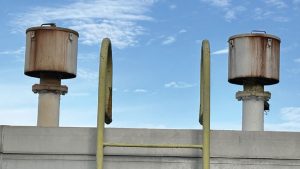
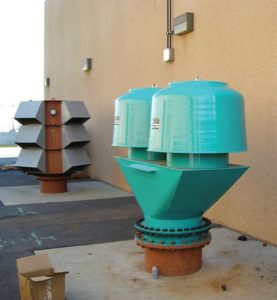
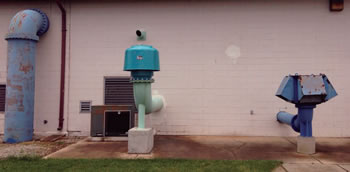
McConnelsville’s old, outdated, corroded filter canisters before the upgrade.

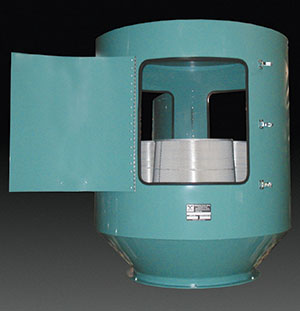
Prior to McConnelsville’s filtration upgrade, they were using outdated canister-type filters (pictured).

The aging filters were no longer capable of mechanically sealing, meaning they were constantly bypassing particulate into the blowers and, by extension, the pipes, valves, and diffusers. Furthermore, the level of corrosion meant the filter canisters had to be opened with with a hammer — and the canister lids weighed nearly 40 pounds. This chore had to be performed twice a year.

After studying the optimized design of Tri-Vent®® Filter Silencers, manufactured by Endustra, Louis understood the engineering principles at work. “My expectations were mostly based on my knowledge of automobile engine performance,” he said. When an engine intake is optimized to reduce restriction, more horsepower is available to move the car. Knowing that these upgrades can result increased performance and fuel economy, Louis used the comparison of high-end after-market auto parts to justify the filter upgrade. His reasoning: if an optimized automotive filter saved fuel in his car, then an optimized blower intake filter silencer would save electricity in his wastewater treatment plant.
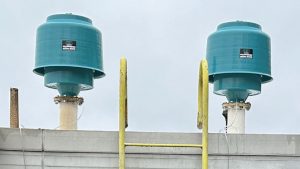
The village of McConnelsville decided to move forward. Removal of the old filters and installation of the new ones, including differential pressure gauges, was completed in one day — before lunchtime.

Louis immediately observed an increase in blower output, and he began to gradually reduce the motor speed a little more each day, until settling on a 12% reduction. By the end of the month, the blowers were tuned to perform with the newly lowered filter restrictions.

The power savings Louis has predicted were correct. “In February, I made it a point to report to my council that the cost savings from January alone were alone over $600,” he noted.

In the first month of operation, McConnelsville had reduced its power consumption by 8,000 kWh (see Electrical Usage Comparison).
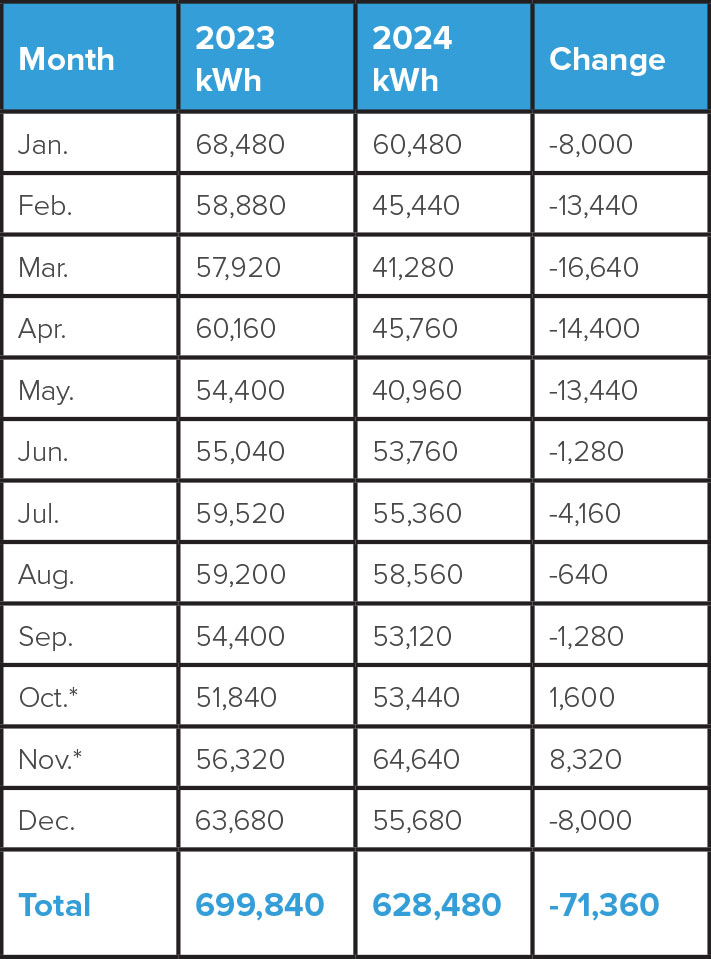

* Spike in power demand caused by cold weather

Electrical Usage Comparison 2023-2024
By May 2024, the Village had completely recovered the cost of its intake filter upgrade. “[For an upgrade] to pay for itself in the five months is an out-of-this-world investment,” said Louis. As well as tracking its electrical expenditure, McConnelsville also tracked filter restriction after the upgrade. The Legacy filters, despite being incapable of sealing, still required two changes per year. By the end of calendar year 2024, both Tri-Vent®® Series P09 intake filter silencers showed only 1.75” WG of restriction. It will likely take two years or longer before the filters reach the final recommended restriction of 6-7” WG.

The new filters are zero-bypass, meaning all the air going into the machine is filtered, and changing filter elements will no require tools — or hammers! Tri-Vent®® Series filters are lightweight and easy to maintain, which will be appreciated by plant personnel.

The first five months of energy savings significantly reduced plant-wide operating costs. Then, in June 2024, the Village of McConnelsville saw a 30% increase in the cost of power per kWh.

The filter change had come just in time. Even with this substantial increase in costs, McConnelsville’s 71,000+ kWh reduction for the year essentially eliminated the financial penalty of the rate increase: the Village spent nearly the same amount of money in 2024 as in 2023, which suggests that the optimized intake filter silencer reduced plant power consumption by nearly 30%. Aside from unseasonably cold weather during October and November, which increased power demand for those months, McConnelsville saw consistent reduction in energy consumption.

Treating wastewater is a necessary but expensive process. Wastewater treatment plants will always need to pump and aerate, and electricity costs will always increase. Between 2023 and 2024, the Village of McConnelsville learned firsthand of both the rising costs of operations and the benefits of optimizing blower intake filtration. With the kWh reductions, McConnelsville realized they’ll be able to combat the rising costs of operations in the future.

Read More

Three Different Sized Wastewater Treatment Plants Save Energy and Maintenance Costs with Aeration Blower Inlet Filter Upgrades

Three Different Sized Wastewater Treatment Plants Save Energy and Maintenance Costs with Aeration Blower Inlet Filter Upgrades, authors are Rob Geyer and Joe DiFederico, published by Blower and Vacuum Best Practices September 2020 https://www.blowervacuumbestpractices.com
Download PDF Article

Energy efficiency and energy consumption are common terms in today’s wastewater treatment industry. Along with pumping, running blowers for aeration is the most energy consumptive part of the treatment process.

To reduce aeration energy costs, operators and engineers adopt better maintenance practices, consult with energy-use specialists, and quite commonly upgrade technologies and facilities. Among the most popular means of achieving better energy efficiencies is upgrading to modern or relatively new technologies like high-speed turbo blowers. However, many plants across the country find that upgrading aeration blowers isn’t always feasible. New blowers can have price tags in the hundreds-of-thousands, not including the cost of engineering and construction. Often overlooked, however, is a simple means of significantly reducing energy consumption: upgrading blower intake filters.

Optimized intake filters can save thousands of dollars annually in energy savings and may not require construction crews, engineering bids, or grant applications. The benefits can also be realized for treatment plants of all sizes. Described below are examples of three wastewater treatment plants that upgraded filters and came out ahead: a small rural operation with positive displacement (PD) blowers, a suburban plant using multi-stage blowers and a large urban plant that had already upgraded to airfoil bearing high-speed turbo blowers.

“Regardless of plant size – small, medium, or large – optimizing intake filters protects equipment and reduces energy consumption.” — Rob Geyer and Joe DiFederico, Endustra Filter Manufacturers

Small Plant Saves Thousands in Energy Annually

A wastewater treatment plant in the Midwest serves a population of just over 2,000. The plant uses PD blowers to aerate their activated sludge. While they meet their effluent requirements, they found their blowers were becoming expensive to run.

The installed PD blowers are not variable speed machines: they run at full power until dissolved oxygen (DO) requirements are met and are shut down pending demand. Using a throttle or control system to increase or decrease speed based on DO levels are not options. Near-constant machine operation leads to increased power consumption, and for small rural communities, expensive plant upgrades are not realistic options.

In 2017, the plant discussed blower filter options with Endustra Filter Manufacturers and installed Endustra Tri-Vent® Series intake filters and filter silencers on all nine of its PD blowers. The patented design of the Endustra filter reduces inlet restriction without compromising filter efficiency, allowing the plant’s PD blowers to produce the required DO with less runtime. And while all blower intake filters act as silencers to an extent, filter silencers have a reactive chamber designed into the filter for baffling sound. Endustra filters and filter silencers incorporate conical cartridge filter elements with proprietary self-supporting synthetic filter media to protect against particulate ingress without excessive restriction of airflow. The elements can be used interchangeably with intake filters or intake filter silencers which provide additional noise suppression.
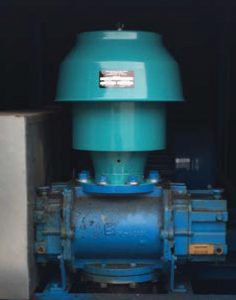
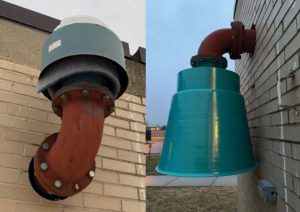
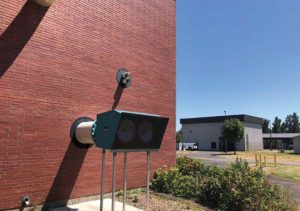
According to plant operators, reaching required DO levels took less time, about 15-25 minutes less per machine. Additionally, less blower runtime led to an approximate power savings of nine dollars per day, adding up to over $3,000 dollars a year, a significant amount of savings for a rural wastewater treatment operation, and more than the total cost of their investment. In addition, the filter elements have only needed to be replaced once, saving on maintenance.

Mid-size Plant Cuts Blower Power Consumption

The Wastewater Department of St. Charles, Illinois, serves approximately 35,000 residents. The department’s two treatment plants and eight full-time employees maintain sixteen intermediate pumping stations and can process up to 20 million gallons of wastewater per day.

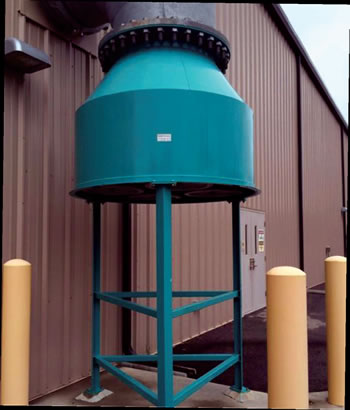
An Endustra Tri-Vent® Series intake filter on a typical
PD Blower.

The single greatest expense of the department’s West-side treatment plant was the power required to operate two multi-stage blowers. While not inefficient by design, multi-stage blowers will consume more power than necessary when improperly accessorized.

The general consensus among multi-stage blower engineers is that the most efficient way to regulate blower flow and pressure on multistage blowers is with inlet throttling. Multistage blower output is regulated via properly balanced throttle settings, and thus multi-stage machines are sensitive to inlet restriction. With excessive inlet air restriction, throttles must be adjusted, and blowers use more horsepower and more electricity. When high restrictions are maintained or final filter restrictions are reached too frequently, blowers more often reach maximum energy consumption for extended periods of time.

The treatment plant knew upgrading blower technology would reduce power consumption, but also realized upgrades require engineering, grant assistance, bond initiatives, and years of planning. In addition, the plant wanted to address maintenance and noise issues related to its existing blower filters.

The St. Charles wastewater treatment plant reduced its energy costs and addressed safety and noise concerns
by replacing the original blower inlet filter (left) for its multistage blowers with a new inlet filter silencer (right).

Chris Rebone, at the time the St. Charles Wastewater Department Assistant manager, encountered challenges with servicing the filters, including issues with safety concerns. Servicing one of the filters required roof access and the other filter, being over 10-feet in the air, required ladders. They also required cleaning or changing almost monthly, and the higher-than-necessary inlet restriction caused excess motor heat, bearing wear, and constant power demands of more than fifty amps. Further, noise levels were elevated to the point that conversation in the blower room was impossible, and blower vibration was knocking
the blower valves out of adjustment.

In early 2019, Rebone decided to replace existing blower inlet filters silencers on the two multi-stage blowers with Endustra intake filter silencers. After installation, the plant throttled the blower inlet valve to achieve optimal output pressures and power consumption decreased by 19 amps. As a result, it reduced initial blower power demand by 50%.

One filter silencer was mounted directly to the blower inlet, eliminating the need for roof access. The other was, a top-outlet filtersilencer that can be serviced without ladders or tools. Noise in the blower room decreased to levels that allowed conversation even at the filter inlet, and vibrations also decreased enough that the throttle didn’t have to be regularly reset. To date, the filter elements have yet to be replaced, filter cleaning has been eliminated, and the filter silencer upgrade paid for itself via power savings in 114 days.

Large Plant Saves Thousands of Dollars Per Year in Maintenance and Energy

The wastewater treatment plant for the City of Eugene, Oregon, has an average daily flow of 34 million gallons per day (MGD) with a peak flow of 277 MGD. Aeration for the plant’s secondary treatment process is
provided by a number of multi-stage blowers and a recently acquired airfoil bearing highspeed turbo blower originally supplied with washable tuck-in polyester filter pads.

An advantage of high-speed turbo blowers like the one at the City of Eugene treatment plant is the potential for energy efficiency. However, these machines can be sensitive to dust ingress and filtration is crucial. Tight tolerances, high RPMs, exposed electronics, and carefully machined aluminum impellers are what make the blowers efficient yet they also make them sensitive to dust. Without optimized inlet filtration, wear on the machines can be accelerated.

At the City of Eugene’s treatment plant, dust ingress on the high-speed turbo blower required vacuuming and scrubbing the blower enclosure. According to Jon Diller, City of Eugene Equipment/Pump Station Maintenance.

The City of Eugene installed an Endustra outlet manifold intake filter silencer at its wastewater treatment plant.

Scalable and Cost-Effective Solution

Regardless of plant size – small, medium, or large – optimizing intake filters protects equipment and reduces energy consumption. Whether it’s an on-or-off PD blower, a throttle controlled multi-stage centrifugal blower, or an energy-efficient variable high-speed turbo blower, best-practice inlet filtration keeps wastewater treatment plants operating efficiently while reducing costs. Upgrading intake filters is a scalable, cost-effective plant upgrade.

Supervisor, plant personnel changed and cleaned the filter pads monthly, and once a quarter, needed to open up the blower enclosure to vacuum and clean the machine interior with a solvent cleaner.

In addition to dust ingress, Diller said the cost of filter pads was mounting. A set of pads cost $1,300 and the plant was spending nearly $10,000 a year on replacements. The pads’ inherent lack of dust-holding
capacity led to excessive restriction alarms on a monthly basis. Unfortunately, the cost for maintenance eroded the benefit of the anticipated energy savings.

In 2017, the core on the blower failed due to dust ingress and needed to be replaced, which led to the plant installing a 24-inch outlet manifold intake filter silencer from Endustra Filter Manufacturers to better protect the blower. In total, it took the plant less than two days to install the filter and new piping needed for the upgrade.

With the new filter in place since 2019, the city has not needed to clean the blower enclosure and there have been no tripped alarms. Maintenance has also been simplified because changing the filter element does not require ladders, manlifts, or even tools. In addition, the plant experienced unanticipated power savings due to the optimized filter’s lower restriction. Based on the positive results of the high-speed turbo blower filter upgrade, the plant began the process of upgrading filters on its remaining blowers.

Read More

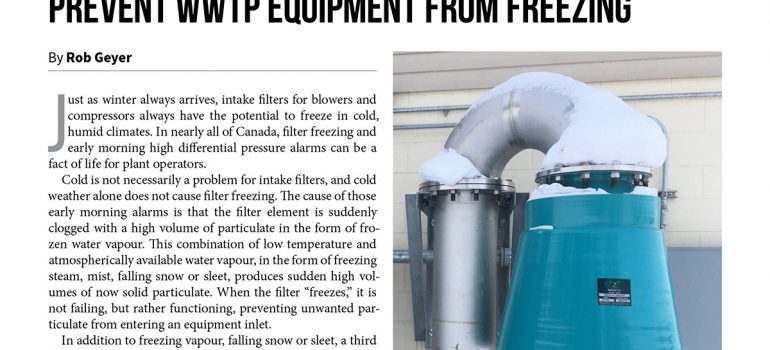
AIR Intake filter recycles waste heat to prevent WWTP equipment from freezing

Air Intake filter recycles waste heat to prevent wwtp equipment from freezing, Rob Geyer author, publication is Environmental science and engineering magazine December 2020 https://esemag.com

Download PDF Article

Just as winter always arrives, intake filters for blowers and compressors always have the potential to freeze in cold, humid climates. In nearly all of Canada, filter freezing and early morning high differential pressure alarms can be a fact of life for plant operators.

Cold is not necessarily a problem for intake filters, and cold weather alone does not cause filter freezing. The cause of those early morning alarms is that the filter element is suddenly clogged with a high volume of particulate in the form of frozen water vapour. This combination of low temperature and atmospherically available water vapour, in the form of freezing steam, mist, falling snow or sleet, produces sudden high volumes of now solid particulate. When the filter “freezes,” it is not failing, but rather functioning, preventing unwanted particulate from entering an equipment inlet.

The Tri-Vent® Series TM09 with freeze discouragement discharge-air knife
was designed to use waste heat generated by air compression

In addition to freezing vapour, falling snow or sleet, a third filter freezing condition is possible, even if the temperatures are above freezing. At 1°C or 2°C, for example, the very action of air rushing through a filter medium can create an evaporative cooling effect, resulting in frost build up on a filter element. In other words, the machine inlet creates its own frozen water vapour and ice. The higher the inlet air velocity, the more likely the problem becomes.

A wastewater treatment plant provides all the necessary ingredients for intake filter freezing. These include high volume inlet air requirements for aeration blowers and a continuous source of humidity, whether from the adjacent body of water (usually a river), or from the aeration basins themselves. These do not freeze, so create steam all winter.

As the mercury approaches and drops below freezing, condensate rising from the aeration basins crystalizes into ice. The blowers draw this ice into the filters, which increases restriction just the same as if the filter were drawing in dust. Endustra Filter Manufacturers designed its Tri-Vent® intake filter with the series DK discharge-air knife, to recycle waste heat to discourage filter freezing.

According to Robert Geyer, company president, older filter designs were more prone to freezing. “We first encountered freezing issues with panel (rectangular) filters,” he says. The industry standard at one time was cellulose, or needle felt polyester filter elements, and filter face velocities were often 75 to 120 metres/minute. Initial restrictions on these traditional filter designs were in excess of 3″ WG (747 Pa) or higher.

Increased velocities resulted in greater suction. When snow or ice was falling, the stronger suction would pull in the dense particulate, and when an evaporative cooling condition existed, frost would build up quickly. Amplifying the problem was the fact that the filters operated at higher restriction levels, making the systems more sensitive to the impact of sudden differential pressure spikes due to a cold snap or snowstorm. Finally, the cellulose media of the era absorbed moisture and the polyester entrained moisture, so the filters could literally freeze.

In the early 2000s, Endustra Tri-Vent® intake filters addressed the deficiencies of legacy designs by operating at low initial restrictions and slower face velocities, often less than 1/2″ WG (125 Pa) and 15 metres/minute. A further advantage of the improved design was proprietary hydrophobic filter media, which created an inherently freeze-resistant filter.

In one plant in Soldonta, Alaska, where average snowfalls exceed 80″ and average high temperatures are below freezing nearly half the year, “freeze resistant” is not enough. During a blower upgrade project, plant operators learned that Endustra offered a freeze discouragement system that did not require additional power and did not negatively impact blower performance. They decided to upgrade intake filters as part of their redesign, and they selected the Tri-Vent® Series DK in a top-outlet filter design.

The Series DK functions by taking advantage of the physics of air compression. Air compression by 5 KPa blowers commonly used in wastewater treatment plants typically increases air temperatures, between 20°C and 90°C This temperature rise, in most applications, is a useless or often undesirable byproduct of air compression. In many situations, the heat must be removed from compressed air to make it usable for a
process. When repurposed to discourage filter freezing, however, the hot discharge air effectively keeps blowers running in harsh weather conditions.

Two schools of thought govern discharge freeze discouragement: volume and pressure. The volume theory holds that 8 – 10% of the total volume of discharge air be redirected to mix with inlet air and bring that inlet air temperature above the freezing point. This method is expensive, not only because a higher volume blower costs more money, but also because the oversizing compromises the energy savings potential inherent in the turndown capacities of modern highspeed machines.

The pressure theory does not require a larger blower. Instead, this method of freeze discouragement works similarly to the way a car’s window defroster operates. Waste heat is routed from the blower discharge and conducted in directed jets of air, only when and where required, and the system operates quietly.

In the case of the Series DK, the total percentage of output air requirement is less than 1 – 2% of the total blower volume, and this volume is further reduced by automated controls which monitor environmental conditions and anticipate freezes, regardless of cause, proactively discouraging the natural consequences only when required, and only using as much discharge air as required.

Air compression by the 5 KPa blowers commonly used in wastewater treatment plants typically increases air temperatures 20 – 90 degrees Celsius.

The operating logic is simple. When the permissible condition of ambient cold temperatures is registered (2°C or less depending on altitude), the controls monitor filter differential pressures. In a properly configured Tri-Vent® filter system, it takes a year or more for element differential pressure to increase 1500 – 2000 Pa above the starting point.

With an average daily increase of less than 5 Pa, if during cold temperature the differential pressure spikes by more than 50 Pa in less than hour, the controls begin to modulate the discharge valve. The valve opens only as much as necessary, until differential pressures begin to decrease, and then gradually closes when differential pressures begin to approach those of the starting point.

So, not only does the discharge knife system use only 1 – 2% of the total blower output, discharge air is used only when necessary.

James Trissel, Soldonta Utility Department Manager, reported that freezing issues, which once happened “all the time” haven’t happened once since startup. Instead of early morning alarms, the filters “take care of themselves.”

The plant utilizes covered aeration basins, and the nearby river eventually freezes over. This means that for much of the winter, there is no rising steam to freeze. Continual regular snowfall, however, routinely caused filter problems during the long, cold winters.

The DK system uses the same logic to prevent all freezing, but another attribute of the system is that discharge air warms the annular air knife in the filter inlet. As the tubular air knife heats, a portion of the radiant heat transfers from the warm metal to the cold inlet air, and any contact snow melts instantly. This radiant transfer is insufficient to melt all the incoming snow, but it will assist the de-frosting action of the air-knife jets.

Interestingly, the air knife does not need to melt or dissuade all the ice or snow on/in a filter. The discharge air only needs to melt a usable portion of the filter media until weather conditions improve. The filter medium does not absorb or entrain water, and the filter element itself doesn’t freeze. Therefore, once the snow stops falling and the air knife melts what remains, the filter element returns to normal operating conditions, and at this point the valve automatically closes. This intermittent control system keeps operation costs low and maximizes filter element life in adverse climates.

The Series DK freeze discouragement system provides an economical solution to a persistent application challenge. It is available on all Tri-Vent® filter arrangements, for connections as large as 48″. A single control panel can operate up to six blowers with individual filters, or supply discharge air to one filter from multiple blowers in a common header configuration.

Read More

Filter Silencers Provide Quiet, Reliable Operation

Filter Silencers Provide Quiet, Reliable Operation, Water and Wastes Digest December 2015 https://www.wwdmag.com
Download PDF Article

Technicians at the Eastern Municipal Water District’s 18-mgd Temecula Valley (Calif.) Regional Water Reclamation Facility struggled with aeration blower intake filters. Each of their three multistage blowers, which operate on natural and digester gas, included a 12-element panel filter housing. The filters were noisy and corroded, and required time-consuming maintenance.

The special-order filter elements re­­quired cleaning or replacement three to four times per year.

In early 2009, the plant contacted Endustra Filters for pricing on replacement filter elements. Endustra offered an alternative: replacing the inlet filter housings with Tri-Vent® Series TK manifold intake filter silencers.

Temecula purchased three Tri-Vent® filter silencers. Because weather had contributed to corrosion in the past, the facility ordered the optional Tri-Coat H2S.

After installation in 2009, improvement was immediately evident. With a 24-in. flanged outlet connection, the TKs require two Tri-Vent® cartridges with Enduralast Hi-Flow synthetic medium. Despite the small size, differential pressures dropped so low that the blowers had to be throttled back, reducing fuel consumption, vibration and noise. The blower inlets are now so quiet that normal conversation is possible directly in front of the filters.

The TKs remain in service, free of corrosion. The filters can be serviced in minutes, and the cartridge elements last 12 months or longer.

Read More

Boosting Blower Performance

Boosting Blower Performance, Authors Robert Geyer and Jim Renk, publication is Water and Wastes Digest October 2008 https://www.wwdmag.com

Download PDF Article

The Onondaga County Department of Water Environment Protection’s Wastewater Treatment Plant (WWTP) features 32 multistage centrifugal blowers, which supply air to eight 1.4-million-gal aeration tanks. The tanks are at the heart of a facility serving the 270,000 residents of Syracuse, N.Y., and much of Onondaga County. Employing state-of-the-art engineering, the plant design features energy efficiency, equipment redundancy and flexible process capacities ranging from an average of 84 to 126 million gal per day (mgd), with a total hydraulic capacity of 240 mgd during wet-weather events.

The original filters were not provided as specified and alternate filters were accepted at the recommendation of the contractor. After all, a simple, passive device such as an intake filter is often not a key consideration in blower packages. The same assumptions about initial restriction, filter cleaning and cost recovery were valid for decades: “Choose a filter rated at 120% of blower capacity and everything will work out just fine.”

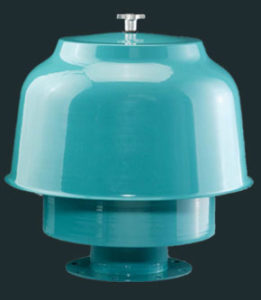
Endustra P09 Intake Filter Silencer

The ultra-modern Onondaga County WWTP, however, originally included a new intake filter specification. In order to realize energy efficiency, the design called for a cartridge-style 8-in. outlet intake filter silencer that offered 99% nominal efficiency on 1-micron particles that would show just 2 in. W.G. initial restriction at 3,300 standard cu ft per minute.

Maintenance Superintendent Jim Renk, who has served Onondaga County for 30 years, was at the time a mechanical engineer for the plant. “Right away, we started having problems with the filters,” Renk said. “The high pressure drop was tripping alarms and collapsing filters, so we reset our alarm limits to protect the blowers and went back and really studied the blower specifications and learned a lot.”

Ross Sanford received the assignment to study the problem and then spearhead the solution. Sanford is now retired, but at the time was crew leader and lead supervisor for the Predictive Maintenance Group at the plant. What Sanford discovered, after studying the original blower specification and then gathering physical data, was that initial restrictions across clean filter elements were in the 4- to 4.5-in. range—double the design specifications. Vibration analysis and laser alignment further suggested that the filters were causing undue strain on the blowers, and high amp draws confirmed that problem.

In order to keep the plant running, the only recourse was to clean filter elements and dispose of them up to eight times a year. Sixteen blower buildings housing 32 blowers added up to more than 250 replacements every year, plus weekly cleanings. Every time an element had to be cleaned or changed, the job required two people.

“The filter lids weighed in excess of 100 lb, and each element weighed nearly 60 lb,” Renk said. “We were cleaning filters all the time, and that was a safety issue because of the excessive weight.”

Temporary Fix

Sanford called upon Edco Sales, a Syracuse-area filtration specialist. Edco brought in Terry Yow, national sales manager for Endustra Filter Manufacturers. Endustra’s inlet filter was used as the model for the performance specifications. Changing the filter housings was the immediate suggestion, but cost concerns initially ruled out a capital expenditure of more than $70,000 for filters that were still considered new.

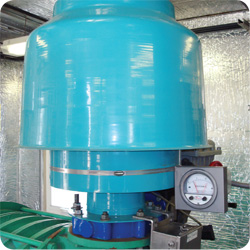
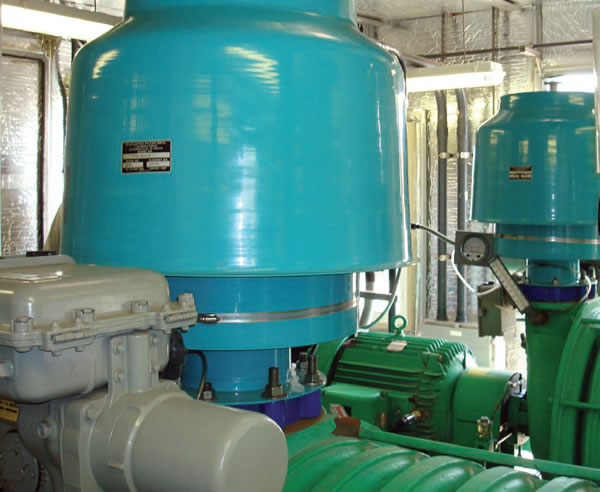
Blower building interior with Endustra Tri-Vent® P09 intake filter silencer and differential pressure gauge at the Metropolitan Syracuse WWTP

As an interim solution, Endustra designed an element to be used with the existing housings that offered increased surface area that could withstand the differential pressures. For the better part of the next year, the plant continued to clean and change filter elements, but the elements were no longer collapsing.

Based on this incremental success, the county purchased a single 95%-at-5-micron Endustra P09 intake filter silencer approved by the blower manufacturer in late 2003. Onondaga staff made plans to conduct a cost-benefit analysis by recording gauge and amp-volt readings every month for one year. The Endustra housing was installed alongside an existing filter, and the testing began.

Initial restriction across the Endustra filter silencer was 0.8 in. W.G., compared to 4.5 in. W.G., and initial amp draws were noted as being 4.5 amps lower. “We had learned that increased surface area would mean the filters would last longer, but it turns out that the design of the filter housing has a lot to do with blower performance as well,” Renk said.

As the months went by, two maintenance technicians continued to change and clean filter elements on 31 of the 32 blowers. The Endustra P09 filter required no cleaning and no changes. Ten months into the test, the gauge read 3.2 in. W.G at 2,200 cu ft per minute—still lower than the initial restriction on the original filters. It was estimated that the filter element might last an additional six to eight months before a cleaning or change would be necessary.

Permanent Solution

Based on energy savings of $2,136 per filter per year, plus maintenance and labor savings, Sanford determined that the payback duration for retrofitting all 32 blowers would be approximately one year. The county fast-tracked the request into the bidding process. Endustra was the successful bidder with high-performance housings and elements, and the entire aeration system was refitted.

Top Image: Aeration basins and blower building exterior at the Metropolitan Syracuse WWTP. Bottom Image: Aeration basins and blower buildings at the Metropolitan Syracuse WWTP. The plant has 16 buildings, each housing two multi-stage centrifugal blowers.

Four years after the installation of the Endustra Tri-Vent® P09s, the county has saved hundreds of thousands of dollars in energy bills and no one cleans filters anymore. “The elements last so long that filter cleaning is no longer cost-effective,” Renk said. “We just wait until the delta-P gets too high. The life on these elements is excellent.”

When it is time to change filters, the job requires only one person and eliminates many safety concerns because the Endustra hood and element each weigh 20 lb. Further benefits realized by making the change include reduced vibration and reduced bearing wear.

Jim Renk is maintenance superintendent for Onondaga County Department of Water Environment Protection. Renk can be reached at 315.435.2260 or by e-mail at jimrenk@ongov.net. Robert Geyer is president and chief executive officer of Endustra Filter Manufacturers. Geyer can be reached at 800.521.1008 or by e-mail at robert.geyer@endustra.com.

Water & Wastes Digest October 2008 Volume: 48 Number: 10
Copyright © 2008 Scranton Gillette Communications 

All of Endustra’s products are manufactured to last. The company’s quality control process begins with order entry and continues as each product continues down the assembly line. Each individual who handles the product is responsible for quality, and is empowered to stop the process if necessary.

“We encourage our employees and associates to think not only about their stage of production, but about what is required from the previous step and what is expected next. We try to get people thinking two or three steps ahead,” says Iylene Wagner, who has supervised production at Endustra since the mid-1990s.

“Our products represent the people who manufacture them,” Yow says. “I’m proud that we’ve met every challenge placed in front of us and achieved so many goals, and I’m also proud of our ability to create a product every industry can use.”

Source:
Published by Phoenix Media Corporation Tel: 312.676.1101 Fax: 312.676.1280
On behalf of Endustra Filter Manufacturers Inc. © 2014 Phoenix Media Corporation. All rights reserved.

Read More

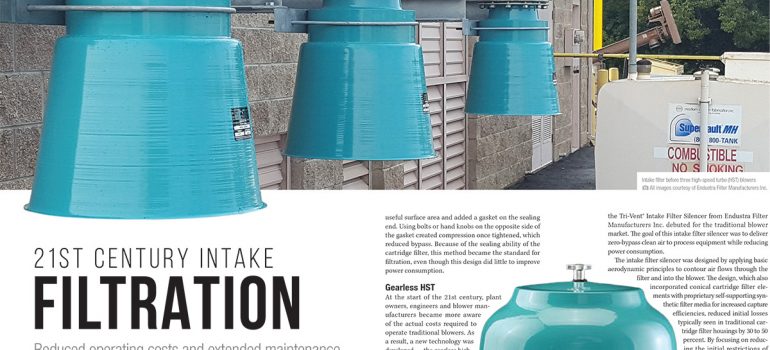
21st Century Intake Filtration

21st century intake filtration, author Patrick Gedgaudas, published march 2017 by Processing Magazine https://www.processingmagazine.com
Download PDF Article

The promise of reducing burdensome energy costs for process air equipment encouraged owners to update blowers, fans and compressors with new technologies that boast higher efficiencies. After transitioning, however, many end users discovered that state-of-the-art process technologies required intake filtration designed for the 21st century. These improved intake filters and intake filter silencers reduced inlet losses and extended maintenance intervals so the design engineer or end user could enjoy the full promise of the new process equipment without compromising process reliability.

Early intake filter options

In the 1980s, energy costs for process equipment were an afterthought. Reliable equipment was the important factor when deciding which technology to install. In the wastewater industry, multistage and positive-displacement blowers were the technology of choice. At the time, only two options were available for intake filtration – panel filters and cartridge filters.

Because power consumption was not a priority, neither method was designed to reduce inlet restrictions. Panel filters required large, heavy housings; were inefficient; and were susceptible to bypass because of the inability to mechanically seal the panel element in the filter housing. The air flow through these housings created pressure losses that negatively affected power consumption, and the bypass of dirty air was transmitted to the process. To improve on this bypass problem, cartridge filters were developed.

The cylindrical shape of the cartridge increased the useful surface area and added a gasket on the sealing end. Using bolts or hand knobs on the opposite side of the gasket created compression once tightened, which reduced bypass. Because of the sealing ability of the cartridge filter, this method became the standard for filtration, even though this design did little to improve power consumption.

Gearless HST

At the start of the 21st century, plant owners, engineers and blower manufacturers became more aware of the actual costs required to operate traditional blowers. As a result, a new technology was developed – the gearless high-speed turbo (HST) blower. The HST used high-speed and frictionless bearings, either air or magnetic, and promised to be the solution to reduce power consumption, noise, and installation and maintenance costs. These compact plug-and-play machines became an instant success because of their energy savings when compared to traditional blowers, but the promise of reduced maintenance was not being realized by all who adopted this technology.

One issue was many of these 21st-century machines used panel filter elements more suitable for HVAC systems. This required the operators of the HST blower to keep their blower rooms clean, change filters often and vacuum the blowers’ enclosures – which made the maintenance requirements more frequent and involved than with the previous equipment.

At about the same time as the development of the HST, the Tri-Vent® Intake Filter Silencer from Endustra Filter Manufacturers Inc. debuted for the traditional blower market. The goal of this intake filter silencer was to deliver zero-bypass clean air to process equipment while reducing power consumption.

The intake filter silencer was designed by applying basic aerodynamic principles to contour air flows through the filter and into the blower. The design, which also incorporated conical cartridge filter elements with proprietary self-supporting synthetic filter media for increased capture efficiencies, reduced initial losses typically seen in traditional cartridge filter housings by 30 to 50 percent. By focusing on reducing the initial restrictions of the intake filter, which in turn reduced the differential pressure required across the blower, the end user gained energy savings and increased the filter element service life by two to three times more than traditional filter designs.

The intake filter silencer, which eliminates bypass, adds efficiency and is designed to extend service intervals, makes possible the HST’s low-maintenance promise, and further reduces power consumption by lowering initial restrictions. Because the improved filter design offers zero bypass, it eliminates dust buildup on the blower’s impeller, helping maintain the technology’s original efficiencies. With a properly designed intake filter silencer, monthly filter element change intervals can be stretched to biannual or annual requirements, further reducing maintenance and its associated costs while better protecting HSTs and process air quality.

Conclusion

The intake filter silencer is energy efficient and extends maintenance intervals. Because of this, it can complement and increase the proven energy efficiencies of HST blowers and help them keep their promise of reduced maintenance.

The energy savings to be gained with 21st century filtration are significant. An initial restriction reduction of 2 inches of water column (WC) on a 300-horsepower, 6,000-standard-cubic-feet-per-minute (SCFM), 8.5-psig HST blower (operating at standard temperature and conditions) can yield a power savings of 4 kilowatts (kW). A 4-kW savings will reduce a power bill by $3,500 per year. This savings will pay for the intake filter silencer in less than two years (see Table 1).

Read More

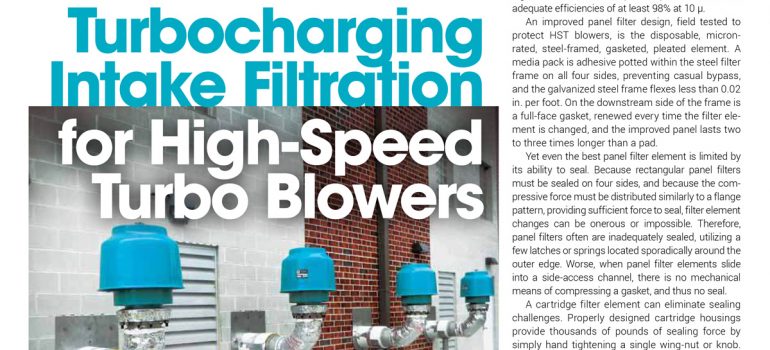
Turbocharging Intake Filtration for High-Speed Turbo Blowers

Turbocharging Intake Filtration for High-Speed Blowers, by Julia Gass & Robert Geyer, published November 2015 by Water & Wastes Digest https://www.wwdmag.com

Download PDF Article

A generation ago, wastewater treatment industry constituents—engineers, equipment manufacturers and owners—agreed that positive-seal cartridge-style intake filtration with efficiencies in the 10 µ or smaller range was the most cost-effective way to ensure machine and process reliability. Blower rebuilds and unscheduled outages far outweighed the maintenance costs of filtration.

A few years ago, high-speed turbo blowers (HSTs) were introduced to the aeration blower market, promising 28% to 30% energy savings and almost no mechanical maintenance, thanks to non-contact bearings, lubricant-free machines and few moving parts. However, within a short time, some plants were having trouble keeping their HSTs running reliably enough to realize the new technology’s promise. One issue was inadequate air filtration, because many vendors were using inexpensive tuck-in pad or beverage board HVAC-style intake filters.

A New Approach

Black & Veatch approached the HST blower with an emphasis on intake air filtration. A track record of successful installations, as well as a growing reputation for solving HST reliability issues with upgraded intake air filtration, suggested that HSTs need air at least as free from particulate as traditional technology blowers. Today, HSTs have reinforced this consensus: Blowers must have clean inlet air. The question that remains is finding the best method to filter inlet air.

HST blower enclosures often utilize a louver in the enclosure wall to draw in air from the room, with panel filters mounted behind for both process inlet air and variable-frequency drive and electronic component cooling air. In this configuration, the blower’s impeller provides the draw for both process air and cooling requirements. In fact, up to 30% of the blower’s process air can be drawn through the cooling air filter. The non-contact bearings, electronics and impellers all need clean air to function, so both inlet and cooling filter elements must provide positive seals and adequate efficiencies of at least 98% at 10 µ.

An improved panel filter design, field tested to protect HST blowers, is the disposable, micron-rated, steel-framed, gasketed, pleated element. A media pack is adhesive potted within the steel filter frame on all four sides, preventing casual bypass, and the galvanized steel frame flexes less than 0.02 in. per foot. On the downstream side of the frame is  a full-face gasket, renewed every time the filter element is changed, and the improved panel lasts two to three times longer than a pad.

Yet even the best panel filter element is limited by its ability to seal. Because rectangular panel filters must be sealed on four sides, and because the compressive force must be distributed similarly to a flange pattern, providing sufficient force to seal, filter element changes can be onerous or impossible. Therefore, panel filters often are inadequately sealed, utilizing a few latches or springs located sporadically around the outer edge. Worse, when panel filter elements slide into a side-access channel, there is no mechanical means of compressing a gasket, and thus no seal.

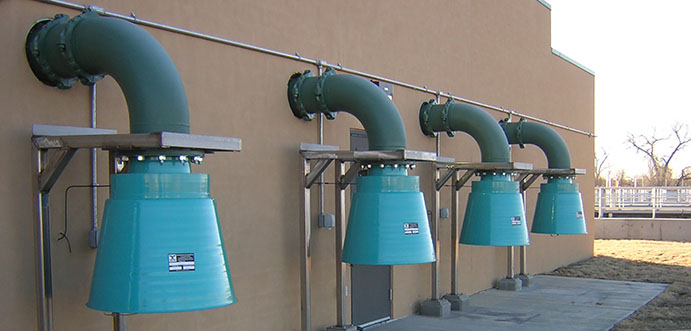
A cartridge filter element can eliminate sealing challenges. Properly designed cartridge housings provide thousands of pounds of sealing force by simply hand tightening a single wing-nut or knob. Tri-Vent® Series P09 intake filter silencers can reduce blower power consumption, but cartridge filter housings do not readily lend themselves to mounting on the outside of the compact HST blower enclosure. Piping the intake air in from outdoors solves this problem without causing an imbalance in the room ventilation. In addition, outside air is cooler, resulting in better blower efficiency.

Black & Veatch implements the cartridge housing design whenever possible. At the Center Street Wastewater Treatment Plant (WWTP) in Mount Pleasant, S.C., the staff reported that air-foil bearing machines, equipped with Tri-Vent® Series cartridge-style intake filter silencers, have reduced overall power consumption by 20% on a dollar-per-million-gal and kilowatt-per-million-gal basis. Plant staff have changed the filters after more than a year since commissioning the blowers. The staff have commented that at the filter intakes, the turbo blowers cannot be heard.

High-speed turbo blowers can hold promise, as evidenced by the following applications.

Pueblo, Colo.

In Pueblo, Colo., the Dilorio Water Reclamation Facility contracted with Black & Veatch to oversee the replacement of its multistage blowers with energy-efficient high-speed turbo blowers. Magnetic bearing machines were chosen, as well as the Endustra Tri-Vent® Series KT8 side-access intake filter silencer with Enduralast Hi-Flow Synthetic 98% at 10-μ cartridge filter elements, and an automatically controlled and SCADA-monitored heated inlet to discourage element freeze-up and provide up to 27,000 cu ft per minute of intake air at less than 2 in. water column initial restriction.

Since 2012, the city’s five magnetic-bearing turbo blowers have operated “seamlessly,” and without a single filter freeze, according to superintendent John Lindstrom. Changing the six cartridge filter elements requires a single operator and less than 15 minutes.

Schererville, Ind.

In an effort to reduce energy consumption, the 8.75-million-gal-per-day town of Schererville (Ind.) WWTP installed an air-foil bearing HST in 2011. Outside inlet air was required, so the town purchased a new four-panel industrial-style filter similar to the version that had protected their positive displacement (PD) blowers for decades.

After startup, all of the power savings claims came true. However, after several warranty repairs, it was discovered that on rainy days, water bypassed the inadequate panel element seals and collected in the blower enclosure. The HST manufacturer recommended that Schererville WWTP Superintendent Jim Gorman contact Endustra.

The single-cartridge Tri-Vent® Series P09 performed so well that the town replaced the remaining filters on the PD blowers, which now act as standby machines to the HST.

Goldsboro, N.C.

In 2014, Robert “Bert” Sherman, director of the city of Goldsboro (N.C.) WWTP, needed to improve the pad filter on his air-foil bearing HSTs.

“You could see where the dirt was getting around the seal,” Sherman said about the reusable frame, and the pads were lasting between 15 to 30 days, depending on the season.

Endustra provided an improved pleated panel filter element with a rigid steel frame, full-face gasket, and Enduralast Hi-Flow synthetic medium.

The improved filter element lasts between 60 and 90 days, depending on the season, and provides a positive seal.

“The Endustra panel does its job,” Sherman said. “Nothing gets by that filter.”

Read More

Obey the Market

Obey the Market, author Staci Davidson, Published by Manufacturing Today fall 2013
https://manufacturing-today.com

Download PDF Article

“To manufacture in the United States is to be proactive,” declares Robert Geyer, president and owner of Endustra Filter Manufacturers Inc. In recent years, he notes, as the market has transformed as a result of increasing energy prices, import pressures and a shrinking manufacturing sector, companies can’t afford to be complacent. And by focusing on being proactive in serving the needs of its customers – along with adhering to its values of reliability, quality, pride and dedication – Endustra has maintained a strong, growing business.

“Any company that operates using a 10- or even five-year-old business model will contract,” Geyer says. “Since 2009, Endustra has secured four new patents, scaled our Tri-Vent® technology to fit applications from 60 to 60,000 CFM, and we have reached out to new technology segments and assisted in adapting their equipment to the American market.

Rather than scale back during the recession, we retooled and refocused our processes to reduce lead times from three to four weeks to three to four days – we don’t feel a customer should have to wait for a filter,” he continues. “We developed proprietary scheduling methods to maintain on-time deliveries for more than 99 percent of all orders. This is what we would like to see from our suppliers, so that’s what we provide to our customers.”

Based in Schererville, Ind., Endustra manufactures its flagship line of the Tri-Vent® series intake filters and filter silencers, as well as replacement filter elements and dust collector cartridges for the OEM and end-user markets. The company is structured to best serve manufacturers of blowers and compressors used in manufacturing, pneumatic conveying and wastewater treatment – or any process that requires a large volume of clean compressed air, Geyer says.

“Our customers are manufacturers and engineering firms, and they expect to be able to tell us what they need, and they assume that Endustra will deliver the product on time and with zero defects,” he says. “Our customers expect us to consistently exceed our promised specifications. They expect unwavering integrity. Quality means getting more than you paid for.”

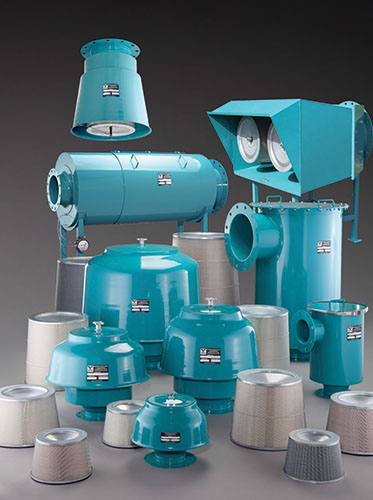
Endustra offers a complete line of Tri-vent® filters and filter silencers.

Quality Products, On Time

Endustra feels it is best and is set apart in its industry because it not only provides performance-based products, but also adapts its technologies to fit customers’ needs. “We don’t even like to use the word ‘custom,'” Geyer says. “When a customer needs something different, something that isn’t on our shelf – whether that is a matched color, private labeling or a completely new design – we standardize the product the customer wants.”

Endustra shies away from the term “custom,” because Geyer believes it implies delays, added costs and difficulties. Endustra’s lean process means it can easily adapt to the needs of its customers, offering “options” instead of “customizations.” “With our process, a customized product is delivered in the same amount of time as a standard product, so by taking away the delays and difficulties, it’s not really custom anymore,”Geyer says. “We ask our customers what they need our product todo, and we deliver.”

Endustra is able to operate this way because of its dedication to quality,which has been in place since it was founded in 1971, but the company really got serious about it in the mid-1980s. This was the beginning of the quality movement in the United States, Geyer relates, and Endustra began self-auditing how it performed in different areas. Eventually, it came up with its own way of tracking conformance. The company starts at the receiving dock, inspecting the raw materials. Then each operator throughout the process does an inspection, and has the authority to reject what was sent to her or him. Once a product is all put together, it is inspected again. Endustra uses visual and metrics inspection to check all finished goods.

“We don’t measure five and approve the lot – we check every single item,” Geyer says. “Everyone has the authority to stop production ifthey see a problem because, in the end, everyone has a responsibility to the customer. No one is reprimanded for catching a mistake – we profitshare, so everyone understands that if we have to do something twice, we’re no longer making money on it. If we find problems we fix them.” Geyer notes that Endustra’s system is so strong that it exceeds the practice requirements of ISO standards and audits, so it has not sought out those certifications. “We are already exceeding that quality documentation and we don’t want to compromise our standards to get that certification,” he says. “We define a reject not as something we have to throw away, but as something the customer catches. It is very rare that an Endustra customer returns a product because it isn’t right.” He adds that Endustra was employing the basic principles of lean manufacturing before that term was coined, and it continues to this day. For example, he notes that the company was able to reduce delivery times from three to four weeks to three to four days, and that was due to a change it how it used inventory, making the process leaner. “The way we are inspecting is also the reason we deliver on time,” he says. “When quality work is done on time, it is delivered on time. We track internal delivery times as well as delivery times to customers. We have 100 percent on-time delivery, year in and year out. If you don’t have to redo work, it’s easy to stay on time.”

Tri-vent® series K08 side-access inline filters scale up for high-volume applications.

Listening and Innovation

Endustra’s growth is being driven by the Tri-Vent® Intake Filters and Filter Silencers, primarily as the result of its innovation and dedication to adapting its technology to the needs of the market, and those needs include reduced operating cost and energy efficiency. Geyer explains that the Tri-Vent® TK Series can provide up to 60,000 CFM of clean air with a footprint that is one-fourth the size of any competing product. The TK requires no tools to maintain and service, and it reduces energy consumption so much that customers can recover the filter’s cost in less than a year.

Geyer notes that this innovation and growth also helps Endustra to remain competitive in the difficult global market. “Our strategy is innovation,” he says. “When challenged by global competition and evolving technologies, a company must listen to its customers, evaluate its products and services, and in the end, obey the market. Every generation of new technology displaces products, expertise and even whole industries out of practical existence. History tells us that companies that embraced the inevitability of changes and the benefit of technological achievement prospered.”

Installed in 2012 at the James R. Dilorio water reclamation facility in Pueblo, Colo., the Endustra Tri-vent® series KP8VCR side-access manifold intake filter silencer provides clean inlet air for five sulzer-abs high-speed turblo blowers.

Continuous improvement and innovation are the hallmarks of Endustra Filter Manufacturers’ current growth, but they have been important attributes of the company’s success since its early years, explains owner and President Robert Geyer. Endustra was founded by Geyer’s father, Robert E. Geyer, Jr., who, working with his father and brother, began selling filters in 1968 and evolved to manufacture filters in 1971 for the local steel industry.

To meet the needs of the market, the company originally focused on inlet filters for reciprocating air compressors, but over time, the operation evolved to focus on centrifugal compressors and pressure blowers.

“Before the phrase was coined, we practiced continuous improvement,and as a result, we developed proprietary technologies and an institutional know-how enabling the company to develop intake filters that reduced energy consumption and filtration costs,” Robert Geyer explains.

By the early 2000s, Endustra was field-testing the patented Tri-Vent® Series of filters, which now is the core of the company’s business.

Robert Geyer had an early interest in his father’s business, asking permission to work full-time in the factory during the summer when he was 13. “By the time I was in high school, I was in put in charge of manufacturing cells, and in college I helped design production lines,” he says. “After finishing my education, I left the company and the industry for 10 years, then came back after my father retired.”

Tri-vent® series TM09 intake filter silencers make filter changes safe, eliminating the need for ladders in most applications.

Always Adapting

Endustra applies the 80/20 rule to its growth goals, Geyer explains. “About 80 percent of growth should come from existing customers because we’ve already won their confidence and we are helping them to grow, also,” he says. “About 20 percent will come from new markets, and we expect to see more of that as new technologies emerge.”

This has been a successful strategy for the company, as is its focus on adapting to the needs of the marketplace. Geyer says that the company’s four patents since 2009 are all “products that were created to meet needs that hadn’t arisen before.” By remaining committed to the air filter industry and strengthened by its internal expertise, Endustra is confident of its ongoing growth.

‘from our point of view, even in a contracting economy, there is opportunity for growth.’ -Robert Geyer

Additionally, even though the marketplace is becoming more global, the American market is still 90 percent of Endustra’s business, and the company remains dedicated to domestic production. Geyer stresses that it doesn’t import any raw material and all of its manufacturing is done at its facility in Indiana. Its operational capabilities are key to its growth goals.

“Every year, we’ve doubled the number of Tri-Vent® TKs we’ve shipped, and that is because the price is right, the footprint is small, and the cost recovery happens in a year or less thanks to energy savings,” Geyer says.

“We are seeing growth in the entire product line, but it is scaled to meet the demands of today’s market. We are proud of what we’ve done – the Tri-Vent® is the right product for traditional equipment and enhances the performance of newer technology machines.

“The Tri-Vent® line can be changed and adapted for any product on the market and any product coming down the pipe,” he adds. “We adapted the line to include configurations of intake filters that didn’t exist a few years ago. Whether a filter needs one cartridge or 10, we can supply it.”

Read More

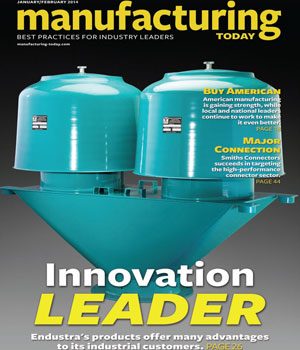
Innovation Leader

Innovation Leader, Manufacturing Today https://manufacturing-today.com

Endustra Filter Manufacturers Inc.’s ability to design and manufacture innovative products that solve its customers’ problems gives it a clear edge in the often stagnant industrial air filter manufacturing market. Rather than rest on its more than 40-year legacy of success, the Schererville, Ind.-based company believes in constantly improving the quality and capabilities of its air intake filter, filter silencer, replacement filter element and dust collector cartridge products.

Installed in 2009, this four-cartridge, 36-inch outlet Tri-Vent® Series TKM Top-Mount Manifold Intake Filter Silencer supplies clean air to Gardner-Denver Blowers at the Mid-Continent Wastewater Treatment Plant in Wichita, Kan.

“Most of the industry is still doing the same thing they’ve done since the 1970s and 1980s, and we’ve innovated at least three times since the introduction of our company (in 1971),” National Sales Manager Terry Yow says. “We’ve strived to improve our products through the years in order to help our customers save on their energy and maintenance costs.”

Since 2009, the company has secured four new patents, scaled its Tri-Vent® line of products from 60 to 60,000 cubic feet per minute of air flow and reached out to new technology segments. Endustra’s newest product line is the Tri-Vent® Series TK of manifold intake filter silencers, which offers high air flow capacity in a space-saving, energy-efficient multicartridge array.

The Tri-Vent® line, introduced in 2004, is Endustra’s flagship product offering. In addition to the manifold Series TK, the line includes five single- cartridge configurations: the Series P04 Intake Filter, the Series P09 Intake Filter Silencer, the Series TM09 Top-Mount Intake Filter, the Series P08 L-configuration Inline Filter, and the Series K08 Side-Access Inline Intake Filter.

All products use hand knobs or wing nuts for element changes as opposed to bolts, screws, or other fasteners that require the use of tools. “People in the field don’t need tools
to change one of our filters,” Yow says. “Our filters can be changed in 10 to 15 minutes versus 30 to 40.”

In addition to their No-Tools design, the patented Tri-Vent® contours air through the filter, reducing restriction and piping losses. The design, which Endustra combines with a conical element and conical lid, reduces energy consumption so significantly that customers can recover the filter’s cost in less than a year, Yow says.

“Most companies in today’s energy-conscious workplace are concerned about energy costs,” he adds. “In an industrial plant or utility plant, energy is a crucial part of their overtwo-head, so anywhere they can save money is important to them.”

Important Partners

Industrial and utility plants make up key segments of the customer base for the Tri-Vent® Series and other Endustra products. The company is structured to best serve manufacturers of blowers and compressors used in manufacturing, pneumatic conveying, wastewater treatment or any process that requires a large volume of clean, compressed air. “Our customer base is very diverse,” Yow notes. “We have good customers that have been with us for many years, and we’ve been able to keep them because we do things right.”

‘Our customer base is very diverse. we have good customers that have been with us for many years, and we’ve been able to keep them because we do things right.’ -Terry Yow

Prominent Endustra business partners include engineering firms that specify its filters for their projects, as well as OEM manufacturers that use them in their own products. Global engineering, consulting, construction and operations firm Black& Veatch specifies Endustra filters in the water and wastewater treatment plant projects designed by its water division. The firm specifies Endustra products to filter the inlet air to aeration blowers in the treatment plants, Black & Veatch Lead Mechanical Process Engineer Julie Gass says.

“Our use of Endustra filters is very widespread, because we haven’t found anyone who makes intake filters equal to what they can do,” she adds.

Black & Veatch specifies Endustra cartridge-type filter elements with proprietary hydrophobic Enduralast® media that resists extreme weather conditions. The conical cartridge design, employing a single-point hand fastener, provides thousands of pounds of sealing force, preventing unfiltered air from bypassing the cartridge. Each cartridge contains a large amount of filter media, meaning they don’t need to be changed as often as panel-type filters, Gass says.

Other advantages of the Endustra filters for Black & Veatch include the energy savings offered by the Tri- Vent® design. “Endustra are very innovative and have continued to improve their product over the last 20 years, while it seems like others are using the same filtration products they used 20 years ago,” she adds.

Endustra also offers Black & Veatch and other customers products designed specifically for their applications. “We appreciate their quality and willingness to partner with us and the continuous improvement of their products,” Gass says.

Carollo Engineers Inc. also specifies Endustra for its municipal water and wastewater plant projects. The company uses K08 and P09 filters within the aeration units, Associate Vice President and Project Manager Garrett Sheehan says.

For Carollo, the advantages of Endustra’s projects include the variety of their configurations and their ease of use. “One of our clients liked the canister arrangement of Endustra’s products because you can drop out the bottom to change it, and they’re lightweight and manageable,” he adds.

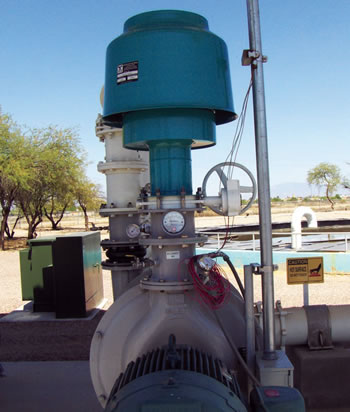
A customized Tri-Vent® Series P09 at the Roger Road Wastewater Treatment Plant, Tucson, Ariz.

In addition to the products themselves, Endustra also offers Carollo and other customers aftersale support. “Having that support and working with people who really know the product is very important to me,” Sheehan says.

Support and customer service are also a reason The New York Blower Company has worked with Endustra for more than 18 years. The industrial fan manufacturer uses Endustra cartridge-type filters within the pressure blower and high-pressure blowers it produces.

“They serve our needs very well and answer our questions quickly and accurately and stand behind their product,” Director of Marketing Dave Maletich says. “Endustra treats us like we’re their only customer.”

Endustra’s products are also standard in the centrifugal blowers manufactured by Hoffman & Lamson.

“We have enjoyed a long relationship with Endustra and use many of their air filtration products, as they are of consistently high quality,” says Keith Collins, market manager for the Pennsylvania-based company. “Endustra’s bottom outlet, single canister Tri-Vent® PO9 filter housing, with its low-pressure-drop design, helps us to achieve the highest efficiency from our blowers.

“We have found Endustra to be attentive to our needs for other filter designs as well. Over the years, Endustra has developed the TM09 top outlet housing, the K08 and P08 inline type filter housings and, for larger air flow requirements, the TK series,” he adds. “The TK series uses two or more filter elements and a housing design that minimizes pressure drop, and enables us to be more competitive by offering little pressure drop within a small package while maintaining high filtration levels with no bypass.

“Endustra has helped us increase our replacement filter aftermarket business by providing us with a custom solution that helps Hoffman & Lamson turn more opportunities into sales.”

Quality Built In

The quality of Endustra’s products is another reason for their acceptance among customers.

“They make an excellent product that works well in all of our applications and testing,” Maletich says. “The quality of their products matches the quality of ours, so we don’t have issues with them when we get into the field. Endustra’s products work the way they’re stated in the catalog; they’re very reliable.”

Single Cartridge Tri-Vent® P09s replace Aging 4-panel Intakes at the Schererville, Ind., Wastewater Treatment Plant.

All of Endustra’s products are manufactured to last. The company’s quality control process begins with order entry and continues as each product continues down the assembly line. Each individual who handles the product is responsible for quality, and is empowered to stop the process if necessary.

“We encourage our employees and associates to think not only about their stage of production, but about what is required from the previous step and what is expected next. We try to get people thinking two or three steps ahead,” says Iylene Wagner, who has supervised production at Endustra since the mid-1990s.

“Our products represent the people who manufacture them,” Yow says. “I’m proud that we’ve met every challenge placed in front of us and achieved so many goals, and I’m also proud of our ability to create a product every industry can use.”

Read More

Endless Reach

Endless Reach, by Alan Dorich, Manufacturing Today, summer 2010 https://manufacturing-today.com

Download PDF Article

At Endustra Filter Manufacturers Inc., team members are driven to keep the company successful, President Robert Geyer says. “Everyone who works here believes in what we’re doing,” he says. “We’ve been blessed with great people who all push in the same direction and keep that wheel moving forward.”

Based in Schererville, Ind., Endustra manufactures intake filters and filter silencers, as well as replacement intake filter elements and dust collector cartridges. Geyer notes that its products are used in virtually any application requiring air supplied by blowers, centrifugal air compressors and industrial fans. “These markets include energy, steel and petrochemical production; municipal and industrial wastewater treatment; potable water treatment; electronics [manufacturing], bottling, baking – the list is virtually endless,” he says.

Geyer’s father, Robert E. Geyer II, founded the company in 1968. “We started as an industrial supplier to the local steel industry, and then began manufacturing as Endustra in 1971,” the younger Geyer says. “We developed a distribution and manufacturer’s representative network in the late 70s and 80s.”

Today, all of the company’s operations take place in its 50,000-square- foot facility in Schererville, Geyer says. “All of our engineering, R&D, sales, manufacturing and warehousing takes place right here,” he says. “More than 99 percent of our raw materials are manufactured in the United States.”

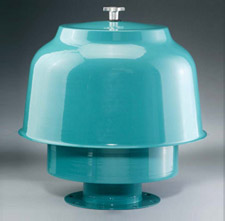
Endustra’s flagship products are its patented Tri-Vent® Series of intake filters and filter silencers. Pictured here is the Tri-Vent® series P09 Intake Ffilter Silencer.

Additionally, Endustra employs a staff that has virtually no turnover. “Most of our associates have been here more than 10 years,” Geyer says, noting that the company has rewarded that employee loyalty with profit-sharing programs.

However, “The real credit, I think, to the quality of our staff is that our customer-first culture inspires pride and loyalty,” he says. “Good people appreciate the opportunity to do good work, and everyone benefits, particularly our customers.”

One such customer, Steve Pucciani, engineering manager for Cincinnati-based ITW Paxton Products, agrees. “[From Endustra], we got a solution that our end customer needed vs. an existing product forced onto us,” Pucciani says.

“Now, from the look of the filter to the labeling on the box, our customers recognize our filters as a Paxton product with Enduralast® technology. Endustra designed and built the product that I needed.”

Waving the Flag

Endustra’s flagship line of products is its Tri-Vent® Series of intake filters and filter silencers, which “offer performance and value that leapfrog other existing intake filter technologies,” Geyer says. He adds that the products reduce inlet filter energy consumption by up to 50 percent over competitive products, without compromising their efficiency.

He adds that he is extremely proud of the Tri-Vent® Series TK Manifold Intake Silencers, the latest addition to the line. “Essentially, we have applied our patented Tri-Vent® technology to high-capacity applications, previously beyond the reach of cartridge filters,” he says.

For instance, what would take eight to 12 heavy panel filters in an older design requires only two lightweight cartridges with the Series TK products, Geyer says.

In addition, “The filters are smaller, lighter in weight and include all of the proven performance benefits of our single cartridge design,” Geyer continues, “reducing energy consumption by enough to pay for the filter in a year.”

The Tri-Vent® Products reduce energy consumption, without compromising efficiency. Below is the Tri-Vent® Series TKT Manifold Intake Filter Silencer.

Initial restriction across the Endustra filter silencer was 0.8 in. W.G., compared to 4.5 in. W.G., and initial amp draws were noted as being 4.5 amps lower. “We had learned that increased surface area would mean the filters would last longer, but it turns out that the design of the filter housing has a lot to do with blower performance as well,” Renk said.

As the months went by, two maintenance technicians continued to change and clean filter elements on 31 of the 32 blowers. The Endustra P09 filter required no cleaning and no changes. Ten months into the test, the gauge read 3.2 in. W.G at 2,200 cu ft per minute—still lower than the initial restriction on the original filters. It was estimated that the filter element might last an additional six to eight months before a cleaning or change would be necessary.

Keeping Committed

Looking ahead, “We’re going to stick to our guns,” Geyer says, explaining that Endustra is committed to manufacturing. “We have products now that other companies don’t have. We’re able to do things that other companies are unable to do in the filter industry.”

Although Endustra has not en­countered competition from overseas, “I suspect we will someday, and I suspect that we will be able to compete,” he says, noting Endustra continuously reinvests in its operations.

“Since 2003, we have completely retooled the plant and already we are upgrading some of that relatively new equipment,” he says, adding that the company recently purchased CNC machines. “We see Endustra as ‘the future of filtration,’ and that means filtration is our future, too. We are already at work on a successor to the Tri-Vent® Series because we know that while we may have industry-leading performance today, we cannot afford to coast.”

In addition, “I think there’s still a future for manufacturing in the United States,” Geyer continues. “We’ll have to keep making things that the rest of the world hasn’t figured out yet.”

Read More